Digital Work
Web design and digital humanities.
The Martin Amis Web
I have overseen and administered the Martin Amis Web since 2006 — the authoritative digital archive for the author. The British Library designated it a site of scholarly significance in 2012 and archives it every six months as part of their ongoing UK Web Archive project. I rebuilt the site in 2006 and completely overhauled and modernized it in 2026.
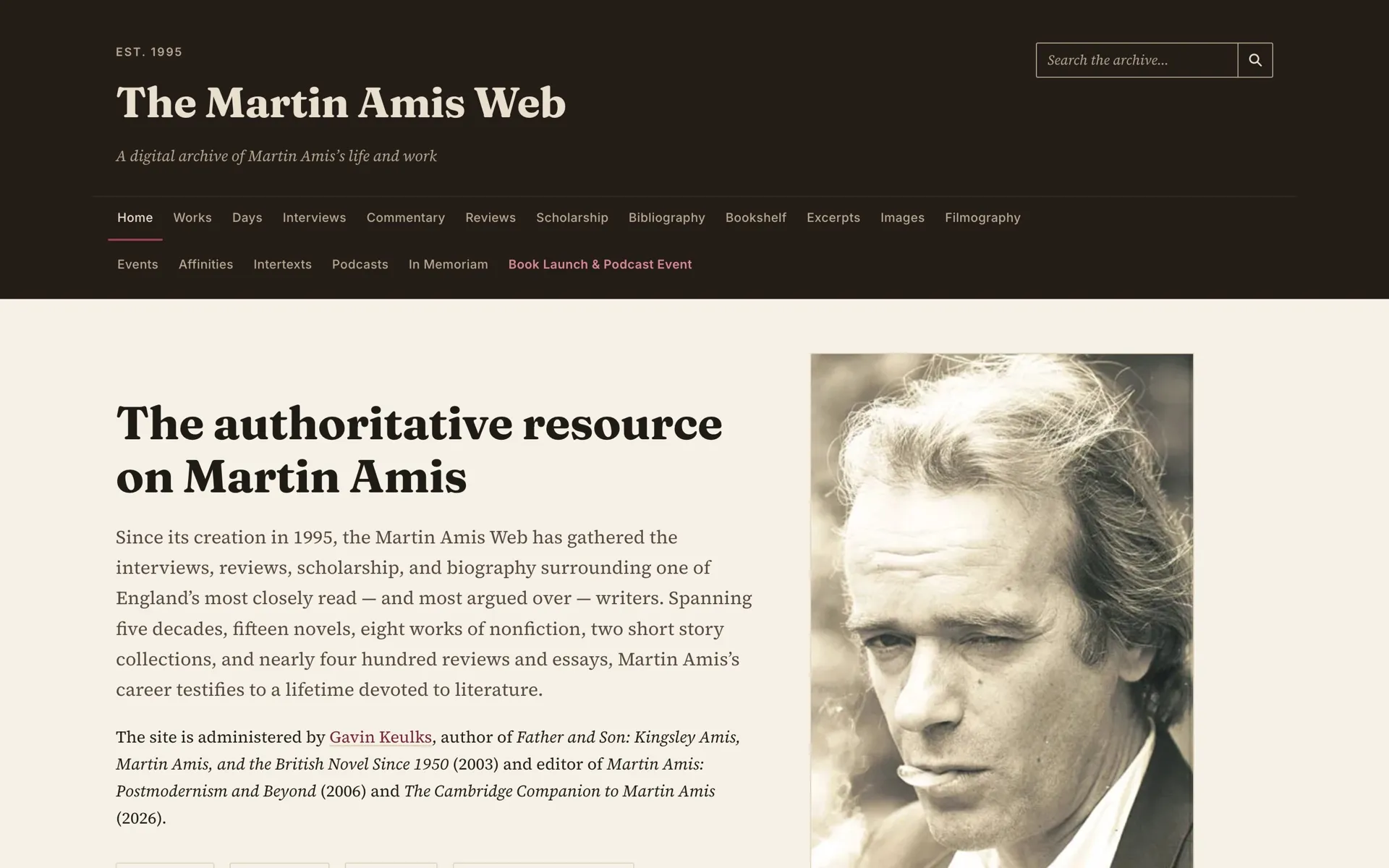
Administering a digital archive for a famous figure has been not only a responsibility but also a subject of my research, spanning numerous conference papers and presentations.
- 2017“Authorship in the Age of Digital Archiving.”Technology, Knowledge, and Society International Conference · Toronto, Canada
- 2012“Shadowy Margins and Sinkholes: Authorship, Online Archives, and IP Law.”Popular and American Culture Association · Boston, MA
- 2011“The Rhetoric of Road-Rage: Authorial Websites and Legal Hit-and-Runs.”Popular and American Culture Association · San Antonio, TX
- 2008“Intellectual Properties: Growth Boundaries in Digital Scholarship and Copyright Law.”Southwest/Texas Popular Culture Association · Albuquerque, NM
- 2007“Digital Humanizing: Administering Author/Scholar Relationships.”Society for Digital Humanities · Saskatoon, Canada
- 2007“Administering Author Websites: Evolving Challenges in Scholarship, Copyright, and Discussion.”Popular and American Culture Association · Boston, MA
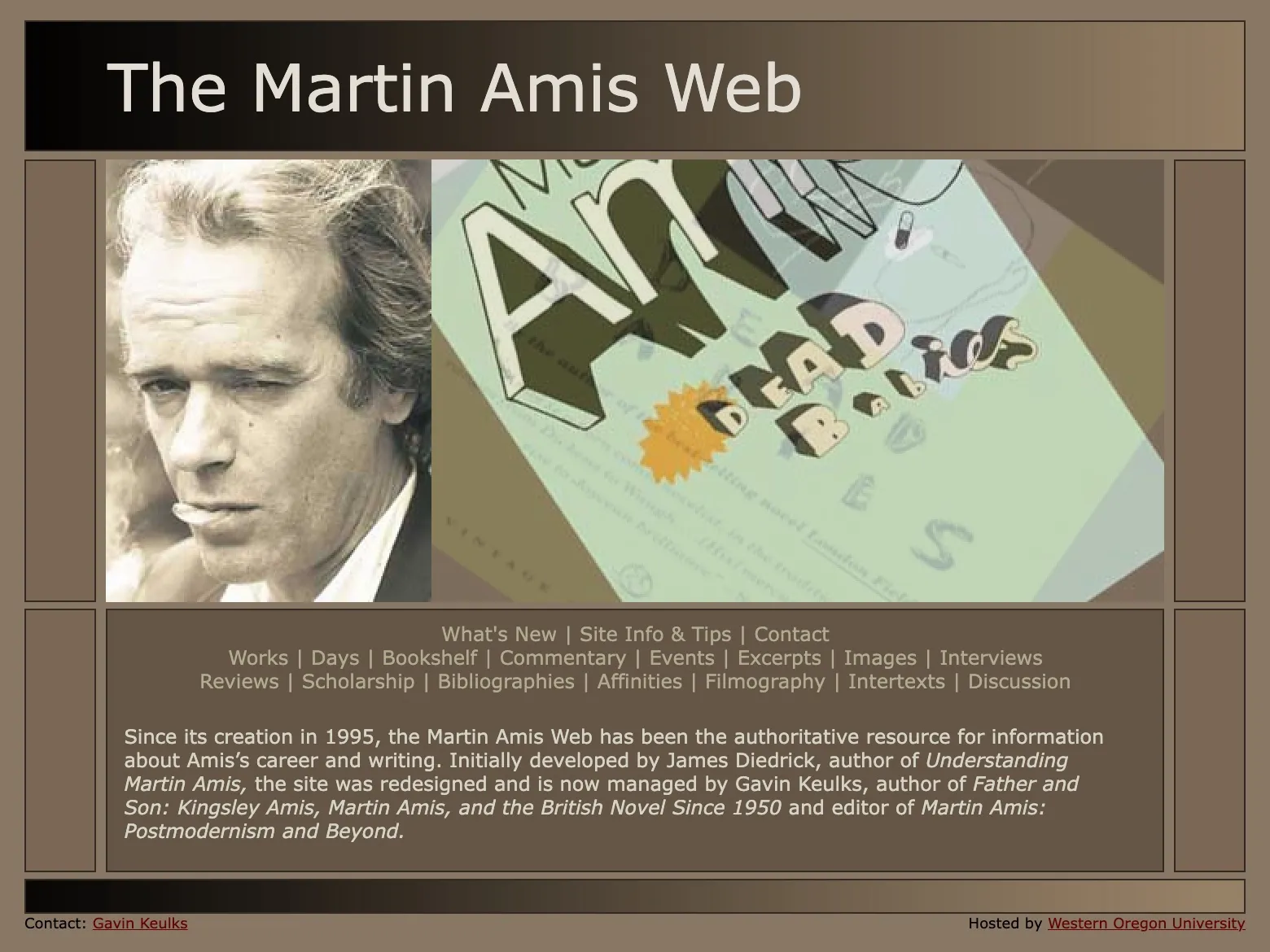
Other Sites
Besides the Martin Amis Web, I have designed and administered three iterations of my personal webpage, plus three institutional sites: the WOU Honors Program (2008–2026), Faculty Senate (2010–2012), and English Department (2007–2009) webpages.
I started programming in 1982, on an Apple IIe, in BASIC. I once asked a mentor whether I should major in computer science in college; his reply was, “No, stick with social science or the humanities — there’s no jobs in computers.” Choose your mentors wisely.